You can reach us via the following :
You can reach us via the following :


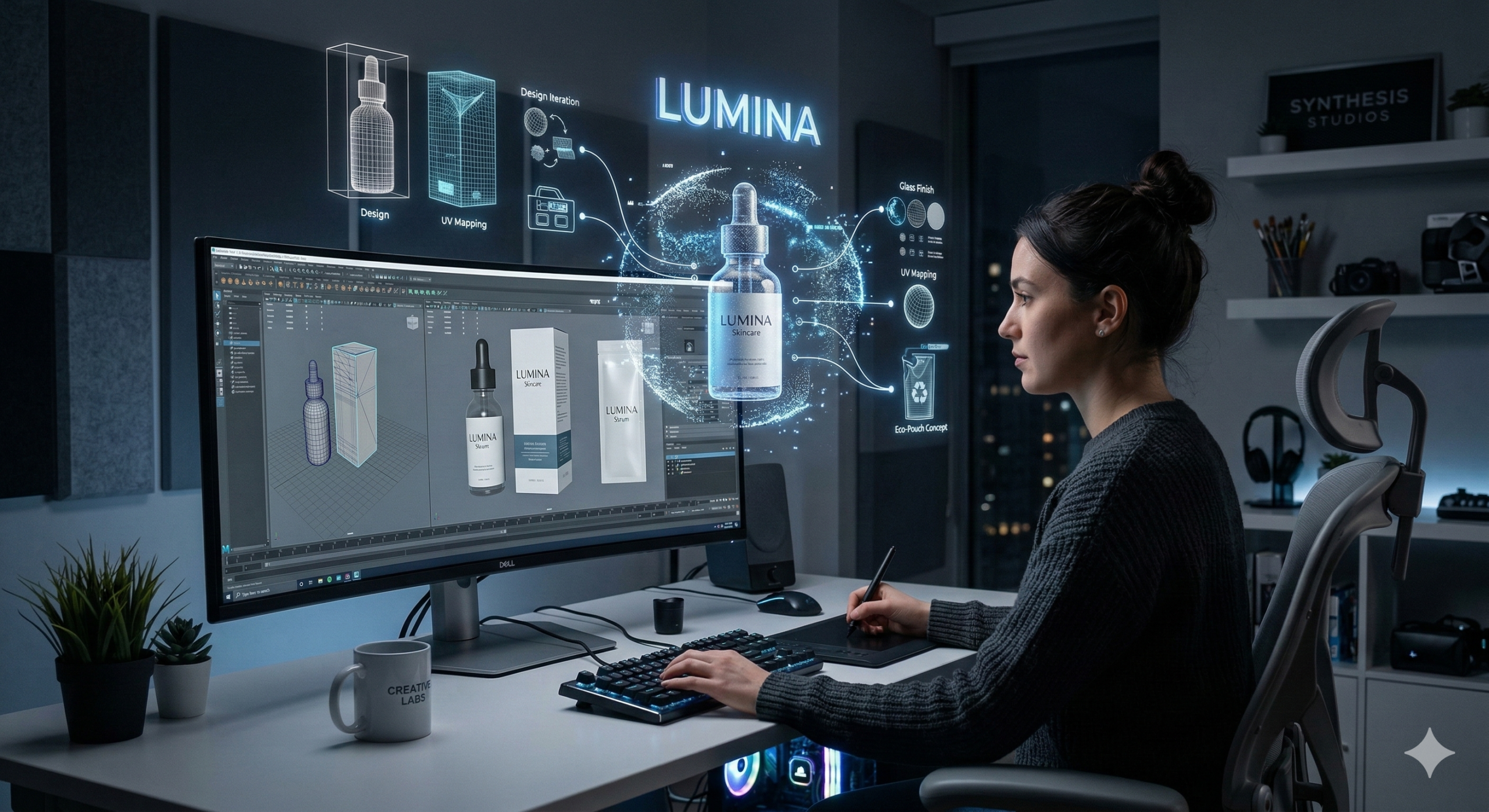
The 3D rendering industry is undergoing its biggest transformation since the transition from ray tracing to real-time engines. For freelance 3D artists who specialize in product and packaging visualization, artificial intelligence isn’t a distant threat—it’s already changing how work gets done, who gets hired, and what clients expect to pay. The question is no longer whether AI will impact small-time artists, but how those artists can adapt, leverage, or differentiate themselves in an increasingly automated landscape.
Artificial intelligence has firmly established itself in the product visualization workflow. Tools powered by machine learning now handle tasks that once consumed hours of a freelancer’s time: generating base meshes from reference images, upscaling low-resolution renders to publication quality, and even suggesting lighting setups based on scene composition. A recent industry analysis found that 65% of creative professionals have already incorporated text-to-image AI into their brainstorming process, signaling that integration is well underway rather than approaching.
For small-time 3D artists, this shift presents both challenges and opportunities. On one hand, clients who once needed a professional for every render can now generate passable visualizations themselves using consumer-grade AI tools. On the other hand, the demand for high-fidelity, brand-compliant product imagery has never been higher—and AI still struggles to deliver the precision and artistic control that commercial work requires.
Despite rapid advancement, AI-generated 3D content faces significant limitations in professional product and packaging visualization contexts. Brand guidelines demand exact color accuracy, precise typography, and consistent material properties across all assets. A packaging render for a consumer goods company must match Pantone colors exactly, display text without distortion, and represent physical materials—cardboard, plastic, foil—photorealistically. Current AI systems struggle with these constraints, often introducing artifacts, inconsistent lighting, or text errors that require extensive human correction.
Beyond technical accuracy, commercial 3D visualization requires creative direction that AI cannot provide. Understanding a brand’s visual language, interpreting abstract brief requirements, and making artistic decisions that serve marketing objectives are inherently human capabilities. A skilled 3D artist brings art direction instincts, technical problem-solving, and client communication skills that no current AI system replicates.
The financial reality for freelance 3D artists has shifted noticeably as AI tools lower the barrier to entry. Clients now have access to “good enough” visualizations at a fraction of traditional costs, which has compressed pricing across the freelance market. Entry-level gigs that once paid premium rates for basic product renders now compete with AI-assisted solutions that deliver acceptable results faster.
However, this compression has also created stratification. Clients who understand the difference between AI-generated placeholder imagery and professional-grade commercial assets are willing to pay premium rates for work that meets rigorous standards. The middle market—work that requires more skill than AI provides but doesn’t demand top-tier artistic direction—has shrunk considerably. Artists who previously occupied this space face pressure to either move upmarket or differentiate through specialization.
Small-time 3D artists who approach AI strategically can actually gain competitive advantages over larger studios. Freelancers can integrate AI tools into their workflow to accelerate initial concepts, reduce repetitive tasks, and explore more variations in less time. A single artist using AI assistance can now produce the volume of concepts that once required a small team, allowing for faster iteration and more responsive client service.
Niche specialization has also become a powerful strategy. Artists who develop deep expertise in specific industries—cosmetics packaging, food and beverage, industrial equipment—build knowledge barriers that generic AI tools cannot easily replicate. Understanding the specific requirements, regulations, and aesthetic conventions of a vertical market creates sustained demand that price-based competition cannot undercut.
The most successful small-time 3D artists are adopting hybrid workflows that leverage AI capabilities while maintaining human oversight and artistic control. This approach typically involves using AI for rapid concept exploration and initial asset generation, then applying professional 3D software skills to refine, correct, and optimize outputs for final delivery. Artists become curators and refiners of AI-generated content rather than pure creators.
This hybrid model also enables more competitive pricing. By reducing time spent on repetitive tasks, artists can offer faster turnaround times or lower rates without sacrificing margin. Clients benefit from improved value while artists maintain sustainable business models. The key is positioning AI as an efficiency tool rather than a replacement, emphasizing the human expertise that transforms raw AI outputs into polished commercial assets.
For 3D artists entering or remaining in freelance product visualization, several strategic priorities emerge from the current landscape. Developing prompt engineering and AI tool expertise has become essential—not because AI replaces the artist, but because competency with these tools is now a baseline expectation. Artists who understand AI capabilities and limitations can better position their human skills in contrast.
Equally important is building strong client relationships and positioning services around strategic value rather than technical execution. Clients who view their 3D artist as a creative partner rather than a render factory are more likely to maintain relationships through market changes. Demonstrating business impact—how visualization drives marketing outcomes, reduces physical sampling costs, or accelerates product launches—justifies premium positioning even as commodity rendering prices decline.
Continuous skill development remains critical, but the focus is shifting from technical software proficiency toward higher-level capabilities: art direction, visual strategy, client consulting, and industry expertise. These are areas where human judgment matters and where AI cannot easily substitute.
Artificial intelligence will continue reshaping product and packaging visualization, but the future for skilled 3D artists remains promising—with caveats. Those who resist change or cling exclusively to traditional methods risk being displaced by more adaptable competitors. However, artists who embrace AI as a tool, specialize strategically, and emphasize human judgment over pure execution will find opportunities in an evolving market.
The core truth is that commercial visualization requires more than technical rendering capability—it demands creative judgment, brand understanding, and artistic direction that AI cannot replicate. Small-time artists who position themselves accordingly will not just survive but potentially thrive in this new landscape.
What’s your experience with AI in 3D visualization? Share your thoughts in the comments below.
Keywords: AI 3D rendering, product visualization freelance, packaging design, AI impact on artists, 3D artist career

No spam, notifications only about new Blog updates
The 3D rendering industry is undergoing its biggest transformation since the transition from ray tracing to real-time engines. For freelance